
Ugly/beautiful

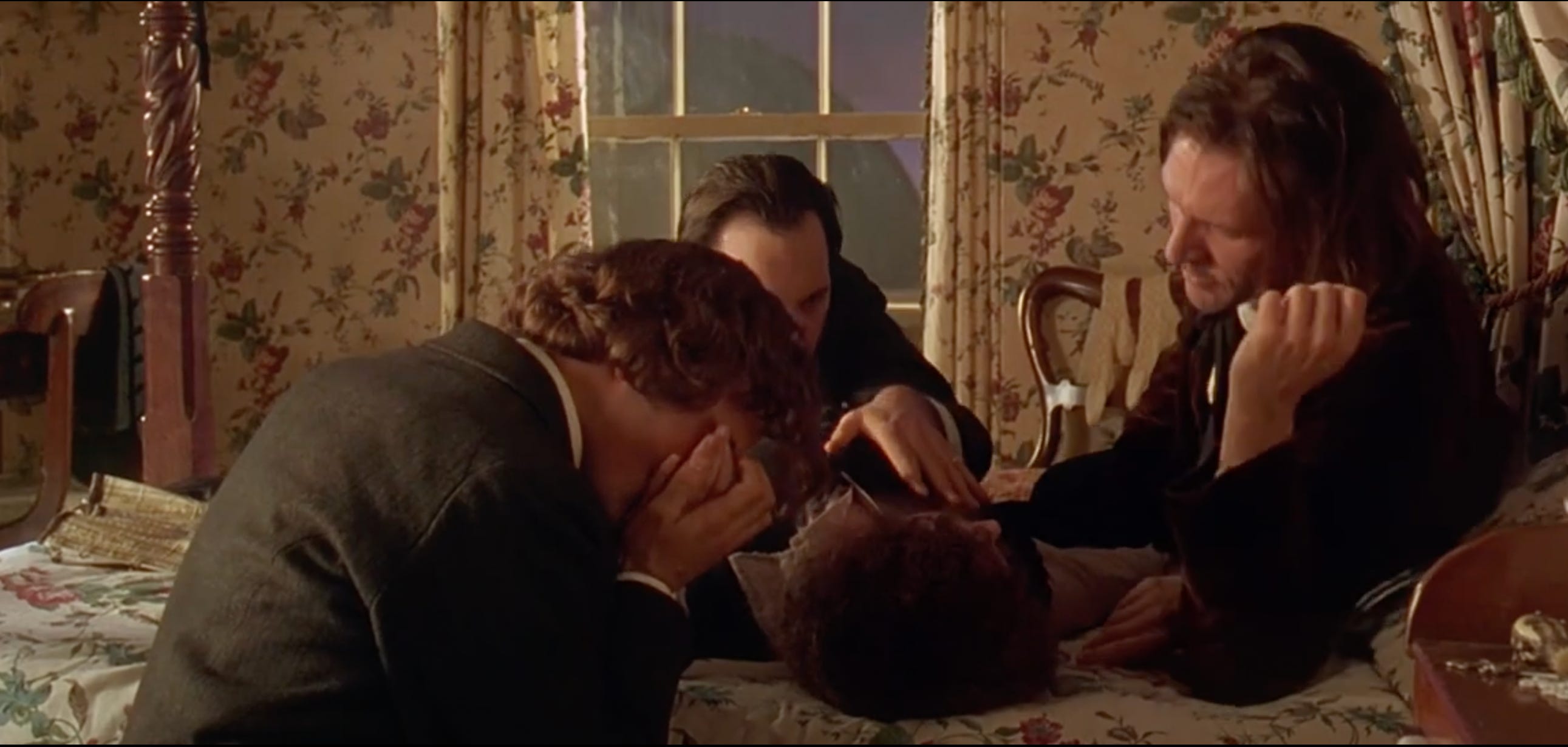
Jane Campion’s The Portrait of a Lady (1996) imagines Isabel Archer lost in a kind of daydream following one of her many marriage proposals (we’re ten or so minutes into the film and she’s already been proposed to twice.) The fantasy mingles Isabel’s material prospects with her erotic life; each man is a potential husband and therefore represents her future domestic and material existence, here uneasily coupled with her sexuality. Will she choose the bullish Caspar Goodwood, her appealing, sickly cousin Ralph, or the honourable Lord Warburton? In showing three potential lovers simultaneously, Campion signals her heroine’s sexual curiosity, (an image of group sex is one of adventure and appetite) the realisation of her declaration moments before that she does ‘not wish to be a mere sheep in the flock’.
I recently rewatched The Portrait of a Lady and what struck me this time was that Campion stages Isabel’s daydream in a room decorated entirely in chintz. The pattern of red roses over pale yellow covers walls and curtains, repeating on the bed on which Isabel’s swooning form is kissed by her three suitors. The scene foregrounds materiality and tactility; Isabel shuts her eyes and brushes her face against the hanging fringe from the four-poster bed, the men are both physically present as lovers and symbolically present in their offer of different material prospects. Isabel’s dilemma is her inability to reconcile sexuality (and therefore adventure) with marriage. Three lovers are compelling in unison, and she can therefore choose none; when she looks at them directly they melt into the chintz from which they emerged.
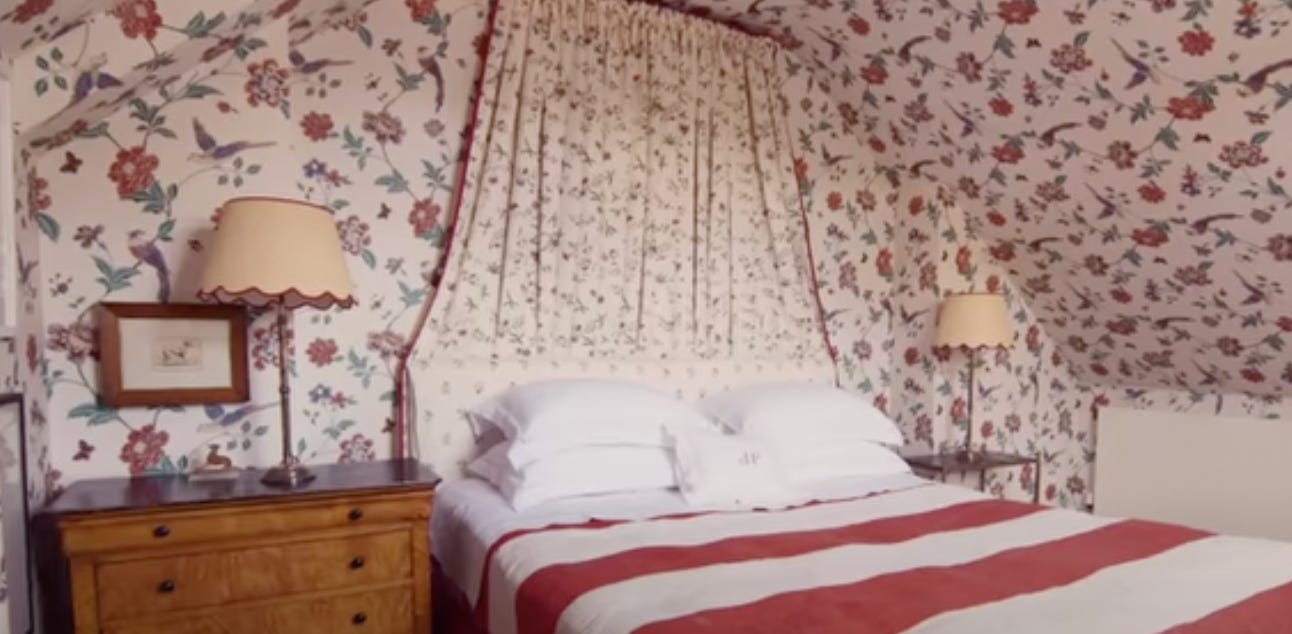
Campion’s staging of a sexual fantasy in a chintz-heavy room is a tour de force of incongruity; the dark and serious forms of the lovers are contrasted against the excessive comforts of bourgeois domesticity. The scene reminded me of an interesting phenomenon I’d noticed in interior design house tours. You’ve probably seen the tours I’m talking about, short films produced by a number of different magazines (House and Garden, World of Interiors etc.) All feature the same format – the viewer is taken on a tour of a designer’s home, the arrangement of each room described in pleasantly soporific detail. The designer is usually a white woman in her mid-late thirties who pronounces ‘room’ as ‘rum’, and somewhere in her house has what I call the ‘chintz torture room.’ For reasons best known to themselves, posh women cover one room in their enormous houses, floor to ceiling, in frightening combinations of blue and pillar-box red. The chintz torture room is ugly, they know the chintz torture room is ugly, and yet they reveal it with relish. There are shades of Jane Eyre’s Red Room, (red rum) and yet these women can’t all have Victorian wards to menace with their baffling interior design choices, so what’s going on here?
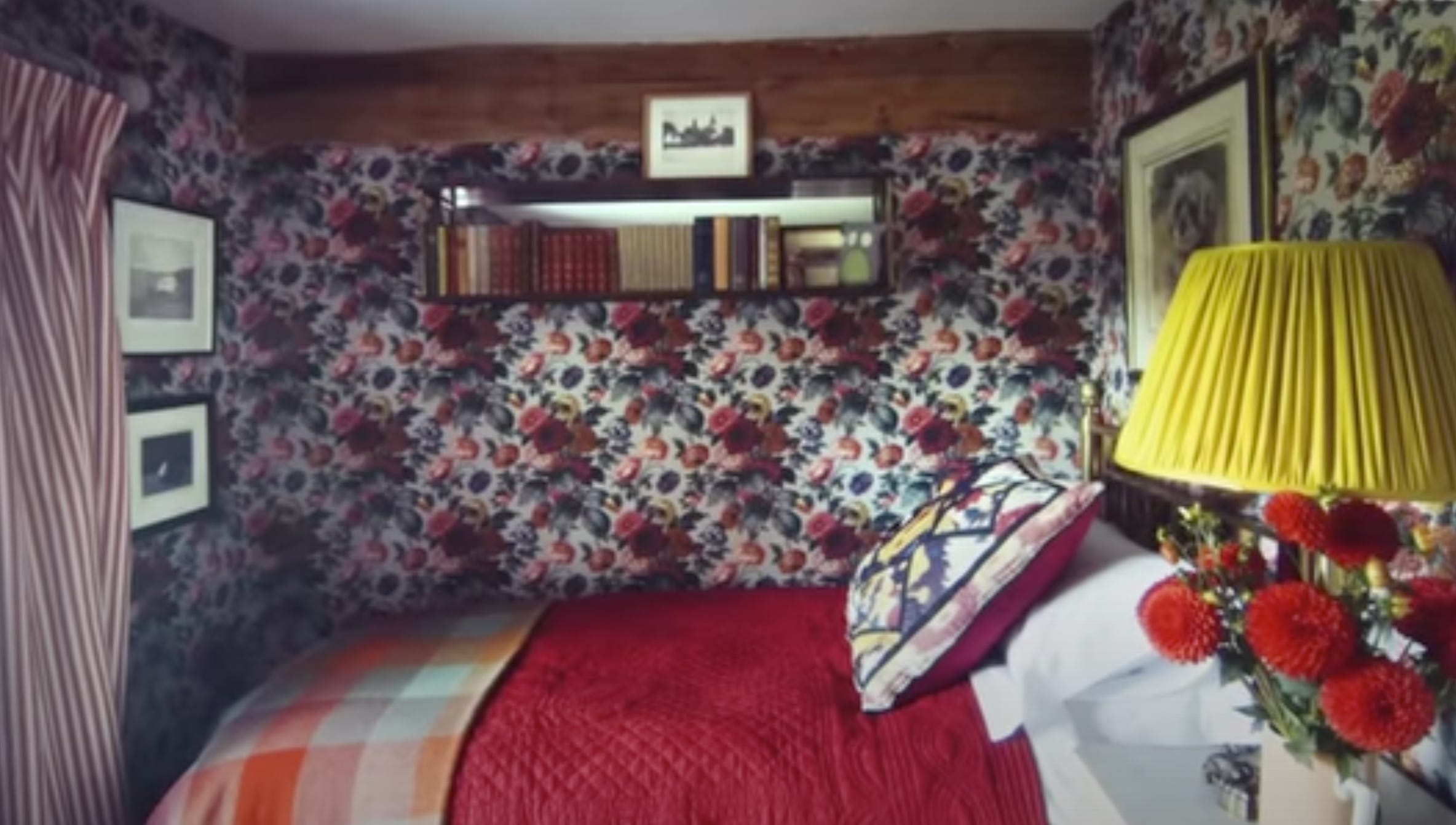
It made me think more broadly about elite taste, which is a complex performance of ugly/beautiful aesthetics and self-conscious anachronism. The women in the house tours say revealing things like “I wanted it to feel like an assault of colour,” with “an enclosed, chaotic feel,” that they were using chintz to create a “different world” that was “not for the fainthearted.” Jane Campion used chintz in the fantasy scene because it was at odds with Isabel’s modernity; it forms part of a visual vocabulary synonymous with the constraint from which she attempts to escape. The chintz torture room, however, revels in the old-fashioned. It is cheeky, knowingly twee, and has repurposed the excesses of nineteenth-century bourgeois domesticity to signal a flouting of tasteful restraint. This is not unconnected to the vogue for maximalism, abundance and excess over the last decade or so. Often presented as a feminist principle of intuitive pleasure-seeking, it purports to disrupt the capitalist logic of exchange value, market prices and other hateful things we all have to think about. I like the idea of indulgence and plenty, and a richness that knows no bounds. I am wary, however, of how quickly this idea has itself been co-opted by the very capitalist logic it apparently seeks to disrupt; certainly providing abundance and excess sits very well alongside increased consumption.
Perhaps the ‘cheekiness’ of chintz is also the subconscious knowledge that referencing old world charm contains a reactionary endorsement of old world ideas, an assertion that large houses should contain the plunder of empire. Sven Beckert writes that the story of chintz is one of “armed trade, colonialism, slavery, and the dispossession of native peoples.” Originating in India and Pakistan thousands of years ago, ‘chintz’ comes from from the ‘Hindi word chint, meaning “‘spotted’, ‘variegated’, ‘speckled’, or ‘sprayed’” as Sarah Fee notes in Cloth That Changed the World (2020). Fee writes that the eighteenth-century development of cotton varieties that could cope with cold climates and industrial processing by US manufacturers ushered in a ‘double tragedy’; the production of chintz was reliant on slave labour and the ‘state-sponsored removal of indigenous American populations.”
I think the performative anachronism of ugly/beautiful taste is partly to do with property, and who we believe is worthy of it. Historically, in Britain at least, the culture of primogeniture has inflected property ownership with virtue, taste and distinction. Property ownership is a moral category - once inherited, now earned by taste. The landowner must show eccentricity and discernment in order to justify the owning of property, a simultaneous assertion and disavowal of privilege. Etiquette bores will tell you that restraint is prized by elites, but in fact each of these design projects is an exercise in excess and grand scale. This is all to say that I think there is a provocation in elite taste, the frisson of discomfort in ugly/beautiful pairings are not an accident. They know what they’re doing, and they know we know too.
Historians quoted from this BBC article.